
Glenroy’s built fabric is dominated by one era of construction: the post-war decade, roughly 1953 to the mid-1960s. Approximately 1,700 homes were built in Glenroy and the adjacent Jacana area by the Housing Commission of Victoria during this period — solid brick veneer construction, three-bedroom layouts on generous rectangular lots, with the pitched iron roof and concrete footpath verge that define the streetscape from Hilton Street to Plumpton Avenue to Stanley Street.
These are good homes. They’ve been owner-occupied, renovated, extended at the rear, and passed through two, three or four generations of families. They’ve proven durable and liveable, which is why so many are still standing and still occupied.
But they’re carrying lock hardware that, in many cases, has never been updated. The original cylindrical deadlocks installed at construction — or the hardware replacements fitted twenty or thirty years later from whatever was available at the local hardware store — do not meet the security specifications appropriate for an external residential door in 2026. In a suburb where residential break-ins run 64% above the Victorian average, with a break-in rate that has increased 12.8% over the most recent measurement period, the lock hardware on the external doors of a Glenroy post-war home is not a minor detail.
This is a guide to what the right deadlock looks like for a Glenroy older home — and how to assess what you’re currently working with.
The AS 4145 Grade Scale: The Measure That Matters
Australian residential deadlocks are assessed under AS 4145, a testing standard administered independently of manufacturers. The grade scale runs from Grade 1 (minimal security function, passage-set level) to Grade 6 (the highest tested resistance to picking, drilling, forced extraction, and physical forcing). For an external residential deadlock — front door, rear door, any entry point of consequence — Grade 5 or Grade 6 is the appropriate specification.
The majority of lock hardware installed in Glenroy homes from the 1950s to the 1980s was never built to modern graded specifications. It predates the AS 4145 standard. The hardware was functional for its era, but resistance to the methods used to defeat locks has improved dramatically on both sides of the equation — better locks, and better tools available to anyone who wants to use them.
Hardware store deadlocks purchased in Australia in the 1980s, 1990s and even early 2000s are not consistently Grade 5. Many are Grade 3 or Grade 4 — adequate for a property in a low-crime context, but not rated to the level appropriate for an active-crime-rate suburb like Glenroy. The difference between Grade 3 and Grade 5 is not a formality — it reflects independently tested performance against picking, drilling, and forced extraction that matters in real-world security events.
Pro Tip: If you’re unsure what grade your current Glenroy deadlock is, look for the grade marking on the face of the lock body — usually a small stamped or printed number — or check the brand and model number online against the manufacturer’s AS 4145 certification. If you can’t find a grade marking or certification, assume it’s ungraded or below Grade 5.
What to Look for in a Deadlock for a Glenroy Home
Grade 5 or Grade 6 rating under AS 4145
Non-negotiable for an external entry. Grade 5 meets the recommended residential security standard; Grade 6 provides additional resistance appropriate for higher-risk properties or front entries facing a less-observed street aspect.
Hardened steel bolt
The bolt — the steel projection that extends into the strike plate when the lock is engaged — should be case-hardened to resist cutting. Some lower-grade locks use a softer steel bolt that can be cut with a hacksaw in under two minutes. Look for “anti-cut bolt” or “hardened steel bolt” in the manufacturer specification.
Anti-drill cylinder protection
The cylinder is the target for a drill attack: a high-speed drill aimed at the keyhole face of the cylinder can destroy the pin stack and allow the lock to be turned by inserting a flat tool. Grade 5 and above cylinders incorporate a hardened steel anti-drill disc behind the face, which deflects or destroys drill bits before they reach the pin stack.
Anti-pick pins
The pin stack inside a standard cylinder can be manipulated into an open position by a skilled picker using tension and pick tools. Security pins — spool pins, serrated pins — in the pin stack interrupt this process, requiring additional tension adjustments for each pin and dramatically increasing picking difficulty. Grade 5 cylinders incorporate anti-pick pin designs as standard; lower grades may not.
Restricted keyway cylinder
A restricted keyway operates on a key profile that’s not available from any retail key kiosk — no hardware store, no key cutting booth at the Wheatsheaf Road shops, no Pascoe Vale Road key kiosk carries blanks for it. Copies can only be cut by the registered system locksmith, with written authorisation from the registered owner. For a Glenroy property where key control matters — rental property, a home with multiple regular access users, a property being sold or purchased — restricted keyway cylinders are the right specification.
Appropriate bolt projection
The bolt should project at least 16mm into the strike plate when fully extended. Many older deadlocks use a shorter bolt projection — 13mm or less — that provides less resistance to the door being forced against the frame.
Steel Security Screen Doors on Glenroy Homes: The Compatibility Question
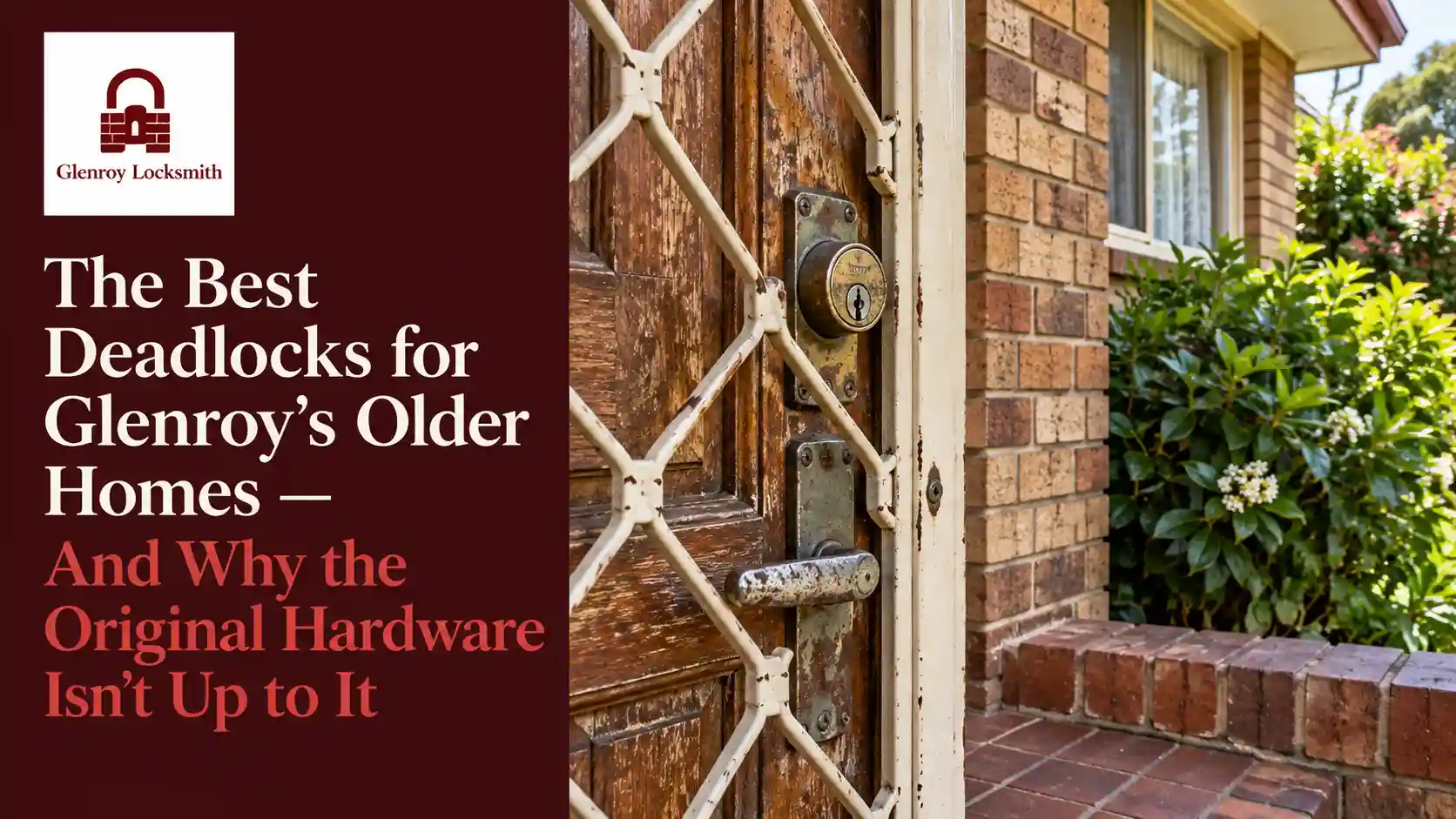
Glenroy’s older brick homes have a high rate of secondary steel security screen door fitting — the heavy steel bar grille doors that were the standard security screen choice from the 1970s through to the early 2000s. These doors provide meaningful forced-entry resistance when the grille and frame are in good condition, but the cylinder fitted to them deserves attention.
Original security screen cylinders on older Glenroy properties are frequently small-format cylinders — a narrower cylinder diameter than the standard deadlock — that predate current security standards. These are often single-sided (key entry from outside, turn button inside) with no anti-pick or anti-drill features.
Replacing the cylinder on an older security screen door with a current-spec small-format cylinder provides an immediate security upgrade without replacing the entire door. The screen door frame itself — if the grille is undamaged and the frame is solidly mounted — may still provide good resistance. It’s the cylinder that’s the weak point.
For Glenroy homes where the screen door frame is deteriorating, loose in the frame, or showing corrosion damage, door replacement is the more appropriate solution. AS 5039-rated security screen doors — assessed to P1 or P2 resistance levels — are available in both traditional steel grille and security mesh formats. P2-rated security mesh doors offer the additional benefit of outward visibility and ventilation in Glenroy’s warmer months, while meeting a higher forced-entry resistance standard than most original screen doors.
Pro Tip: Pull the security screen door frame away from the primary door frame slightly at the hinge and lock stile. If there’s significant movement — more than 5mm of flex — the fixing screws are loose, the frame is deteriorating, or the mounting isn’t reaching structural timber. A screen door that moves in the frame isn’t providing the resistance its grille implies.
The Rear Door Problem on Glenroy’s Extended Homes
Glenroy’s post-war homes have been extended. The standard Housing Commission layout was a compact three-bedroom home with a kitchen at the rear. In the decades since, families have added rear family rooms, larger kitchens, laundry extensions, and alfresco areas — a pattern visible across Hilton Street, Daley Street, Plumpton Avenue and virtually every residential street in the suburb.
These rear extensions introduce additional entry points. The door from the rear addition to the backyard — often added as a basic external door with a passage set fitted by the building contractor — is frequently not fitted with a deadlock. A passage set provides a latch that holds the door closed; it’s not a security lock, and it can be defeated by a sharp impact or by working the latch mechanism through a gap in the door frame.
I check rear entry deadlock status on every Glenroy property I assess, and the absence of a rear deadlock is the most common single finding. On the original front entry, most homeowners have at some point replaced or upgraded the hardware. The rear addition door — added later, by a different person — has often never received the same attention.
A Grade 5 deadlock fitted to the rear entry and keyed alike to the front entry is a straightforward job that takes under two hours and closes what is often the most accessible unobserved entry point on a Glenroy post-war home.
Strike Plate Upgrading: The Most Overlooked Improvement
No deadlock review of a Glenroy older home is complete without the strike plate. The face-mounted strike — the flat plate with a morticed hole that the bolt engages — is almost universal on original 1950s–70s construction.
These plates are held by two to four screws that penetrate the door lining timber but don’t reach the structural jamb behind it. The door lining is 12–19mm of softwood — the bolt’s resistance under a kick is only as strong as those short screws holding in that soft timber. The result: a well-fitted Grade 5 deadlock on a face-mounted strike can be defeated by a determined kick in under ten seconds, because the force bypasses the lock entirely and attacks the door lining.
A full-box strike — a deeper plate with a three-sided pocket for the bolt — fitted with 75–100mm screws that reach the structural jamb converts the door from “kick-resistant” to genuinely kick-resistant. It’s the single highest-leverage upgrade available on most Glenroy older homes, and it’s done at the same time as a cylinder change or rekey appointment.
A Hilton Street Security Upgrade: The Assessment
I was called to a 1958 brick veneer on Hilton Street — a long-term homeowner in her seventies who’d been broken into two streets over and wanted to know where she stood.
Front entry: an original front door with a late-1990s replacement cylinder, Grade 3, non-restricted keyway, face-mounted strike with 25mm screws. Security screen: original 1980s steel grille, small-format cylinder, single-sided, no grading. Rear of the property: a family room extension from the early 2000s, external door with a passage set and no deadlock. Two windows at the rear with original friction latches. No external lighting at the rear.
We replaced the front cylinder with a Grade 5 restricted-keyway cylinder, upgraded the strike to a full-box strike on 90mm screws, fitted a new small-format Grade 5 cylinder on the security screen, fitted a Grade 5 deadlock on the rear extension door keyed alike to the front, and fitted key-operated locks on the two rear windows.
The property went from having one partially effective lock and three unaddressed entry points to having Grade 5 hardware on every external entry, a restricted keyway, and a unified key. Two visits, three hours total.