
Glenroy has one of the more active rental markets in Melbourne’s north. With 37% of households renting, a vacancy rate that sits consistently low, and a growing stock of new townhouses alongside the suburb’s established brick-veneer rental base, Glenroy attracts property investors who know that proximity to the Craigieburn line, Gowrie Station and the Pascoe Vale Road amenity strip makes this an easy-let suburb.
For landlords managing one or more Glenroy rental properties, the physical security and access management question is typically handled reactively: new tenancy means cutting new keys, tenancy end means chasing key returns and deciding whether to rekey, a property manager change means hoping the access history has been properly documented. Each event is its own operational problem.
A master key system replaces reactive management with designed, controlled access. This is how it works and why it makes sense for a Glenroy rental portfolio specifically.
The Standard Access Problem for a Glenroy Landlord
Walk through the access history of a typical Glenroy rental property over three years. It might be a brick veneer on Daley Street, or a townhouse in the new stock off Wheatsheaf Road. Each tenancy involves the issue of two or three keys. Tenants request additional copies over the course of the tenancy — sometimes with the landlord’s knowledge, sometimes not. The property manager holds a set. A maintenance contractor may have been issued a copy for the duration of a longer job. At tenancy end, some keys come back. Some don’t.
By the end of three years and two or three tenancies, a Glenroy landlord may have fifteen to twenty keys in circulation on the property profile — issued at different times, to different people, in different circumstances — with no reliable way to account for all of them. The standard operating response is to rekey after any tenancy that ended badly, and accept the uncertainty otherwise. This is a risk management decision, not an access control decision.
The specific problem with standard key profiles on Glenroy rental properties: the keyway is almost always a non-restricted profile, meaning copies can be cut at the Pascoe Vale Road key kiosk, at the hardware store, or at any retail key cutter in the suburb. A tenant who wants a copy for a family member, or who wants to retain access after a tenancy ends, can have one cut without the landlord knowing. A restricted keyway cylinder, managed through a licensed locksmith as the registered system holder, removes this option entirely — copies can only be issued by the locksmith with written authorisation.
Pro Tip: Register your Glenroy master key system under your own name as the property owner, not under the property manager. Property managers change; the system registration shouldn’t. When you register as owner, the key control remains yours regardless of who’s managing the property at any point.
How a Master Key System Works for a Rental Portfolio
Cross-keying is the mechanism behind a master key system. Each lock cylinder is pinned to respond to two different key patterns: the individual key for that specific door, and the master key that operates all cylinders in the system. The cylinder doesn’t know which key it’s responding to — both operate correctly — but no other key does. The security of the lock against an outsider is unchanged.
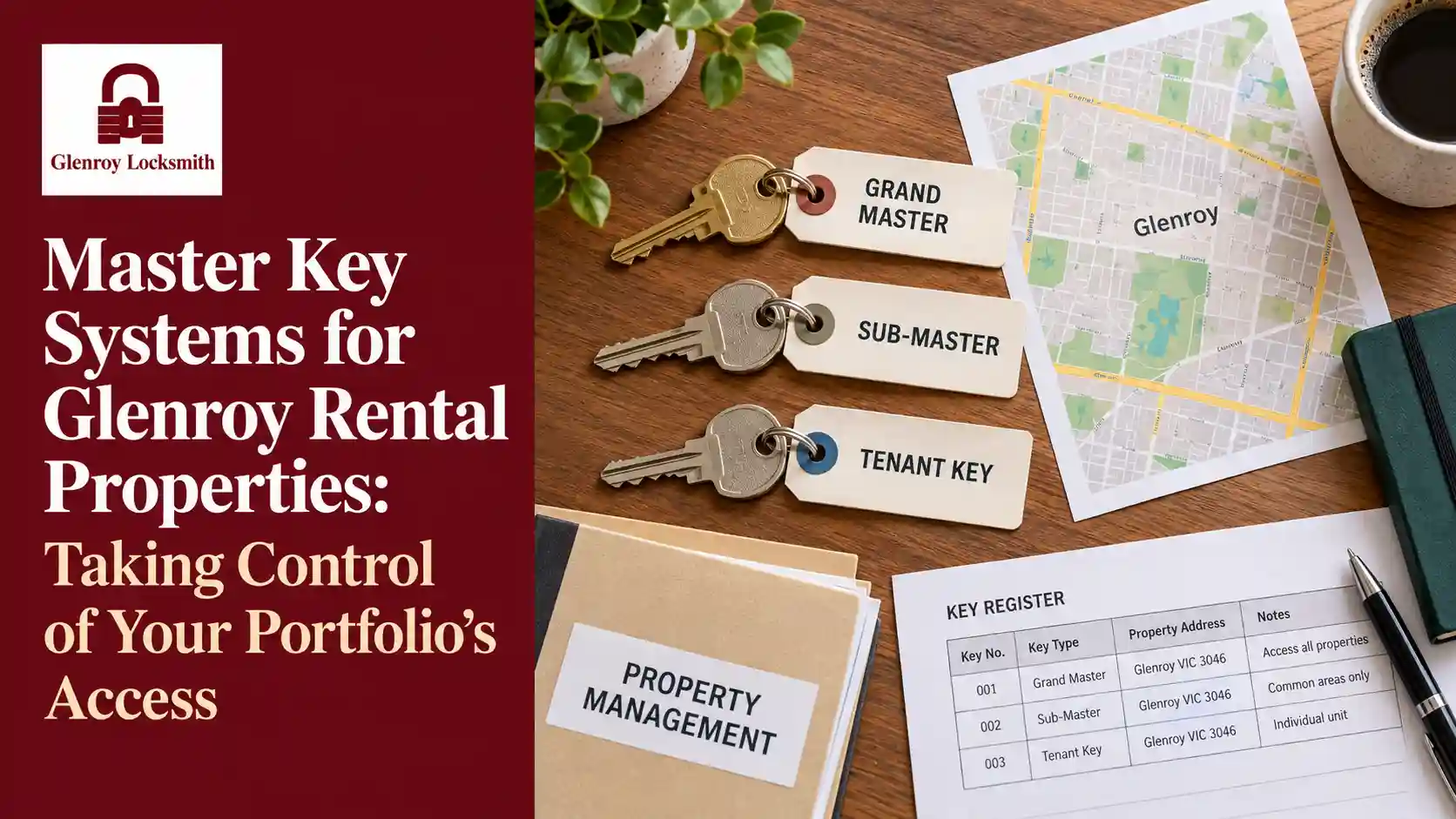
For a Glenroy rental portfolio, the hierarchy typically runs across three levels:
Individual tenant keys
Cut to the specific pin configuration of the tenant’s property. Opens the front entry, rear entry, and any other keyed doors at that property — and nothing else. A tenant in a Daley Street property cannot use their key to access the landlord’s Wheatsheaf Road property.
Property manager sub-master
Opens all properties in the system. One physical key handles all inspections, all emergency access requests, all maintenance coordination across every property. The property manager doesn’t need a labelled key for each property — one key is all that’s needed.
Grand master
Also opens everything. Typically two copies, held by the landlord. Stored securely and separately as the backup to all other access. If the property manager key is lost, the grand master is not affected — the property manager gets a new sub-master, and access control is maintained.
Restricted keyway
The keyway profile for all cylinders in the system is a restricted one, managed through the system locksmith’s account with the cylinder manufacturer. No retail key cutter can duplicate any key in the system. The landlord’s key register, maintained by the locksmith, documents every key issued, to whom, on which date, and the authorisation behind the issue.
Rekeying Within the System: The Clean Tenancy Transition
The operational advantage of a master key system becomes most visible at tenancy transition — the moment when access accountability is highest-stakes.
With a standard non-master-keyed rental property, a tenancy end creates a decision: rekey or not. If the tenancy ended in dispute, the answer is usually yes. If it ended cleanly with all keys returned, many landlords skip it and absorb the risk. Either way, the decision is made without certainty about whether all key copies have been returned.
With a master key system, the response to any tenancy end is standardised: a rekey appointment within the system. The locksmith repins the cylinder or cylinders at that specific property so the previous tenant’s individual key no longer works. The property manager sub-master continues to work unchanged. The landlord grand master continues to work unchanged. The new tenant receives new individual keys, signed for in the key register.
The operational cost is a service call for the rekey. The return is certainty: the new tenancy begins with provably clean access. The new tenant’s keys, and only those keys, work on their property. No decision to make, no uncertainty to accept.
Pro Tip: Build the cost of a post-tenancy rekey within the system into your Glenroy rental property’s annual operating budget as a standard line item. A master key rekey costs less than a full lock change and delivers the same certainty — at scale, across a portfolio, it’s significantly more economical than the irregular and reactive approach it replaces.
Setting Up a Master Key System on Glenroy Properties
A master key system setup visit covers every external entry point at each property. The locksmith assesses the existing hardware at each location and determines whether to repin existing cylinders into the system or replace them with new restricted-keyway cylinders.
For Glenroy’s established brick veneer rental stock — typically a front entry deadlock, a rear door, and sometimes a security screen door — the assessment usually finds a mix of conditions. Some cylinders are in good condition and can be repinned into the system if the brand is compatible with the locksmith’s system hardware. Others are worn or are a brand that doesn’t accept repinning — these need new cylinders, which is also the opportunity to upgrade to Grade 5 hardware if the existing units are below spec.
Security screen doors on Glenroy properties require particular attention: the secondary screen cylinder needs to be incorporated into the system, or the screen becomes a nuisance (a separate key) or a vulnerability (left permanently unlocked because it’s inconvenient). Including the screen door in the master key system, keyed alike to the front entry within the tenant’s key pattern, resolves both.
For newer Glenroy townhouses added to a portfolio, the cylinder hardware is typically current-generation and compatible with master key system incorporation — the primary question is whether the existing keyway is a brand the system locksmith can match.
Managing Multiple Glenroy Properties: How the System Scales
A master key system’s value increases as the portfolio grows. A single-property landlord benefits from key control and clean tenancy transitions. A three-property landlord benefits from everything above plus the property manager sub-master — one key, all inspections. A six-property landlord has a documented key control infrastructure that demonstrates competence to property managers, provides clear protection against key dispute liability, and handles every tenancy transition as a scheduled appointment rather than an ad-hoc response.
Adding a new property to an existing Glenroy master key system is significantly less expensive than setting up a new standalone system. The system infrastructure — the keyway registration, the hierarchy design, the key register — already exists. New cylinders for the additional property are priced as additions to the existing system, and they integrate into the same property manager sub-master and landlord grand master without requiring any change to existing keys.
A Glenroy Portfolio Setup: The Two-Property Brief
I was engaged by a Glenroy landlord managing two rental properties in the suburb — a three-bedroom brick veneer near the Northern Golf Club boundary and a two-bedroom townhouse in one of the newer Wheatsheaf Road-area releases. He’d had an uncomfortable dispute about a missing key at the end of the brick veneer tenancy the year before, and the uncertainty about how many copies were out there was weighing on him.
Brick veneer: original front entry deadlock from a 1990s hardware store replacement, non-restricted keyway, worn cylinder — replaced with a Grade 5 restricted-keyway cylinder. Security screen: older small-format cylinder, single-sided — replaced with a current-spec small-format cylinder keyed into the system. Rear door: passage set only — fitted with a Grade 5 deadlock incorporated into the system.
Townhouse: current builder-standard deadlock, good condition, repinnable brand — repinned into the system. Rear sliding door: secondary lock fitted and keyed into the system.
Setup: one full working day across both properties. The landlord received two grand master keys; his property manager received a sub-master. Both tenancies received new individual keys, signed for in the key register. System register established and provided to the landlord.
First tenancy transition, six months later: a rekey appointment at the brick veneer, ninety minutes, new keys to the incoming tenant, register updated. The landlord described the certainty it provided as worth three times the service fee.