
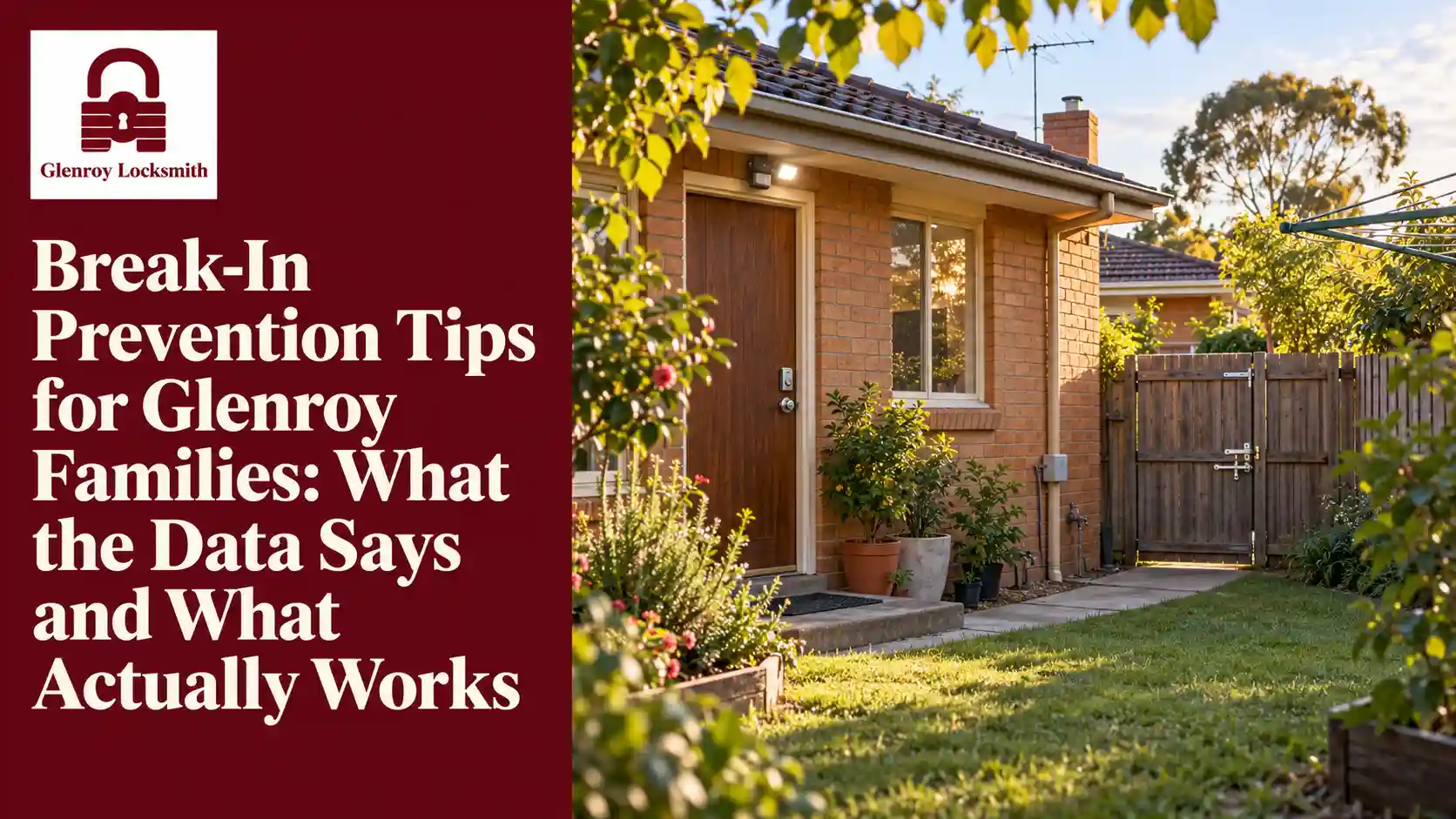
Glenroy’s property crime data is worth being honest about. Break-in rates in the suburb run 64.2% above the Victorian average and 60.2% above the national average, based on the most recent Crime Statistics Agency data. The rate has increased 12.8% in the most recent measurement period. Motor vehicle theft sits 16.3% above the Victorian average. The suburb’s overall crime rate places it around the 84th percentile of Victorian suburbs for residential burglary — meaning 84% of Victorian suburbs have a lower break-in rate than Glenroy.
These numbers don’t mean Glenroy is dangerous to live in — it’s a suburb of families, community organisations, active street life on Pascoe Vale Road and Wheatsheaf Road, and a strong local identity. But the crime data does mean that property security in Glenroy is not an abstract concern. It’s a real, present risk that homeowners and renters in the suburb have every reason to address practically.
The good news is that residential burglary is heavily concentrated on opportunistic entry — entry through accessible, low-resistance points made when the property appears unoccupied and unobserved. Targeted, deliberate burglary of a specific property does occur, but it’s a minority of incidents. The majority are opportunistic, and opportunistic burglary is deterred by a relatively modest set of security measures applied consistently.
This is what those measures look like for Glenroy’s specific housing stock.
How Opportunistic Burglary Works in an Inner-Northern Suburb
Glenroy’s urban character creates specific conditions for opportunistic burglary that are different from an outer-growth suburb. In Glenroy, properties are close together, but the diversity of the housing stock — original brick veneers on large lots, recent townhouse developments, older flats on side streets — means that surveillance between properties varies significantly.
The post-war brick veneers that dominate Glenroy’s residential streets have a consistent layout: a front garden between the property and the street, a driveway to one side, a backyard accessible from the side passage between the house and the fence. The side passage is the critical access point: it’s typically a narrow gap, often with a gate at the street end, that leads from the front of the property to the rear without passing a window that faces the street. From the street, an approach to the rear of a Glenroy brick veneer via the side passage is often less visible than it appears.
The rear of the property is where entry is typically attempted: a rear door with a passage set rather than a deadlock, a window with an old friction latch, a laundry or bathroom window accessible from the side passage. A property where the rear can be approached with low visibility and where the rear entry points have weak hardware is a higher-probability target than a property where approach to the rear is clearly surveilled and the entry points have appropriate hardware.
Pro Tip: Walk around the outside of your Glenroy property — not from the footpath, but from the side passage and rear — and ask honestly: how visible is this approach from the street or from neighbouring properties? Is the rear entry resistant to a skilled or persistent attempt? The answers show you where your actual exposure is, not the theoretical exposure.
The Specific Vulnerabilities on Glenroy’s Housing Stock
Side access gates
The gate on the side passage of a Glenroy brick veneer is frequently fitted with a basic latch bolt — a spring-loaded latch that holds the gate closed but isn’t locked. A latch bolt can be lifted from above or reached through a gap in the gate paling. The fix is a key-operated gate bolt or a padlock hasp, securing the gate so that access from the front of the property to the rear requires either defeating the gate lock or going over the fence — a significantly higher commitment than lifting a latch.
Rear entry door deadlock
As discussed in the deadlock blog: the rear door on a Glenroy property — particularly the door on a rear extension added in the 1980s or 1990s — is frequently fitted with only a passage set. A passage set doesn’t lock. The rear door of a Glenroy home with a passage set is not secured when everyone leaves in the morning. A Grade 5 deadlock on the rear entry is the first priority for any Glenroy property that doesn’t have one.
Louvre door panels
Original 1960s–70s construction in Glenroy sometimes included louvre ventilation panels on rear laundry or bathroom doors — rows of glass or aluminium blades in a tilted frame. Original louvre panels can be removed or broken without interacting with the door’s lock hardware at all. If a Glenroy home has an original louvre door on any external entry, the lock on that door is providing minimal actual security. The replacement is either a solid-panel security grille door or boarding the louvres with a security panel.
Window latches on older aluminium frames
Aluminium sliding windows from the 1970s and 1980s are common throughout Glenroy’s brick veneer stock. Original friction latches on these windows are closure mechanisms, not locks. A window fitted with a friction latch is held closed by the latch’s spring tension — enough to prevent wind movement, not enough to prevent deliberate forcing. Key-operated window locks — fitted to the sash or the frame of the window itself — convert a latched window into a locked one in under thirty minutes per window.
No external lighting at the rear
The rear of a Glenroy brick veneer is often completely dark after sundown — no garden lighting, no motion sensor at the back door, no illumination of the approach path from the side gate to the rear entry. A motion-activated sensor light at the rear of the property changes the risk calculation for a nighttime approach: visibility, the possibility of being seen, the implication of an occupied and aware household. Sensor lighting is the lowest-cost deterrence improvement available and is consistently in the top five security investments by return per dollar.
Pro Tip: Fit a sensor light at the top of the side passage — aimed to illuminate anyone approaching from the gate toward the rear — and a second at the rear door itself. Two lights, under $200 in hardware, thirty minutes to fit, and they cover the two points of maximum exposure on a Glenroy brick veneer rear approach.
The Layered Security Framework: Why One Change Isn’t Enough
No single security improvement eliminates burglary risk. What reduces it is a sequence of overlapping improvements that make the property progressively more difficult, more visible, and more time-consuming to enter without authorisation.
Physical security layer
Deadlocks at Grade 5 or above on every external entry. Keyed gate bolt on the side passage. Window locks on accessible ground-floor windows. This layer makes every entry point resistant to quick, low-skill forced entry. An opportunistic entrant who encounters proper deadlocks on both the front and rear entry, and a locked gate on the side passage, has to either commit to a higher-skill attempt (picking, drilling) or move on. Most move on.
Deterrence layer
Sensor lighting on side and rear approaches. A P2-rated security screen on the front entry — visible from the street, providing a clear signal that this property has considered its security. CCTV cameras covering the approach paths — the sight of a camera changes the probability calculation for an opportunistic entrant even if it doesn’t physically prevent entry.
Detection layer
A monitored alarm with a response service rather than a local bell. An unmonitored bell alarm in a residential street creates noise but doesn’t guarantee a response. A monitored system means that a triggered alarm generates a monitoring centre response — either a patrol to the property or a call to the homeowner — that escalates beyond noise.
Glenroy Households and the Daily Absence Window
Glenroy is a suburb of working families and commuters. The Craigieburn line, the Upfield line and the M80 carry Glenroy residents to work across Melbourne. By 8:30–9am on a weekday morning, a large proportion of Glenroy’s occupied dwellings are empty — adults at work or in transit, children at Glenroy Central, Belle Vue Park, Corpus Christi or one of the suburb’s other primary schools.
The absence window runs until school pickup and after-school activity collection — effectively 3pm to 5pm for households with school-age children, or to 6pm for households without. A six to nine-hour daily absence window, consistent across the working week, is the condition that opportunistic daytime burglary exploits.
The security response for this pattern is the physical security layer first — rear deadlock, side gate lock, window locks — because these are the improvements that change the outcome of an approach, not just its probability. Deterrence and detection are valuable additions, but a deterred entrant who shifts to a lower-security Glenroy property on the same street is still a break-in somewhere. Physical security improvements make an actual entry more difficult even when deterrence has failed.
A Stanley Street Area Assessment: The Full Walk-Around
I was called to a family home on a residential street off Stanley Street — a young family who’d had an attempted entry at the rear of the property, discovered because a rear window was visibly forced without the glass being broken. They wanted a complete assessment.
Front entry: Grade 4 deadlock, functional, non-restricted keyway, face-mounted strike plate with 30mm screws. Security screen: older steel grille, cylinder functioning. Side gate: standard latch bolt only, no lock. Rear entry door: passage set with no deadlock. Rear laundry window: aluminium slider, friction latch only. No lighting at the rear. Garden shed at the rear fence: unlocked padlock hasp, tools inside including a shovel and a pry bar.
Assessment: the attempted entry matched the profile. Approach via the side gate (latch lifted), attempt at the rear window (friction latch partially forced), abort when resistance required more noise or time than was comfortable for a daylight approach.
We fitted a keyed gate bolt on the side passage gate, installed a Grade 5 deadlock on the rear door, fitted key-operated window locks on the laundry window and the rear kitchen window, mounted two sensor lights (top of side passage and above the rear door), upgraded the front strike to a box strike on 90mm screws, and fitted a proper closed-shackle padlock on the garden shed hasp.
The attempted entry had used the property’s own tools in the initial approach — the shed padlock was the last thing we discussed, and the homeowner was genuinely surprised to realise it was part of the picture.