
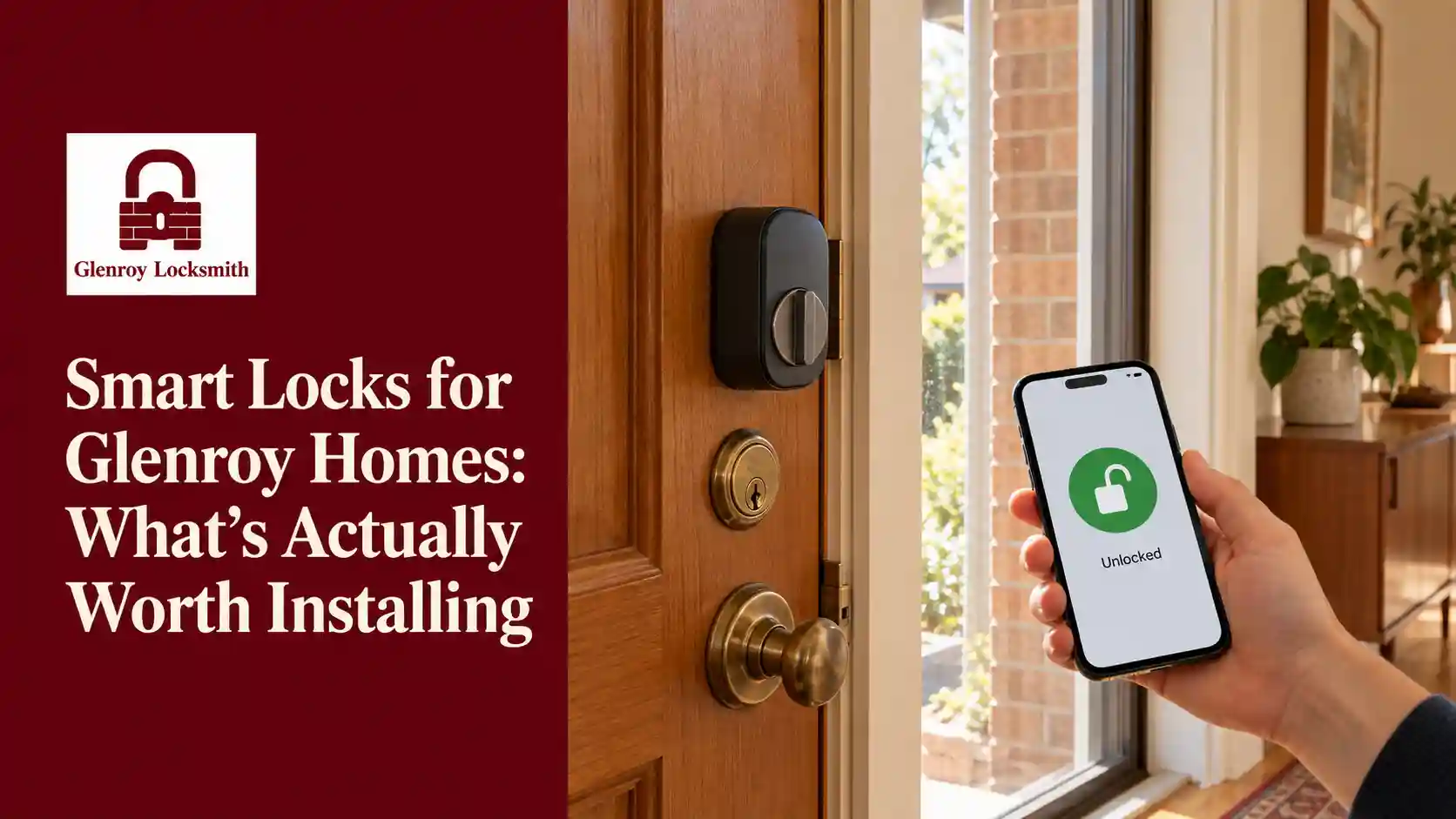
The smart lock category has expanded rapidly in the last five years, and the marketing has expanded even faster. Walk through the lock aisle at Bunnings and you’ll see a row of products that look identical in the photograph and span an enormous range of actual capability, build quality, and security specification. The price range alone — from under $100 to well over $500 for a residential smart lock — suggests that these are not the same product in different packaging.
They’re not. And for Glenroy homes specifically — a suburb that includes 1950s brick veneers, 1990s security screen doors fitted to non-standard frames, newer townhouses off Wheatsheaf Road, and everything between — the question of which smart lock suits your property is not answered by a general internet search. It’s answered by knowing what’s on your door and what the product you’re considering actually does when it gets there.
I fit smart locks across Glenroy regularly. Here’s what I’ve learned about what works, what doesn’t, and what the suburb’s housing profile means for compatibility.
The Two Smart Lock Approaches: Retrofit vs Full Replacement
The distinction that matters most in smart lock selection for a Glenroy home is whether the product retrofits to the existing lock or replaces it.
Retrofit smart lock adaptors fit to the inside face of the existing deadlock cylinder. The product mounts over the turn button on the inside of the lock and motors it open and locked using the app, PIN pad, or Bluetooth trigger. The external appearance of the door — keyhole, handle, deadlock face plate — is completely unchanged. The original cylinder remains in the door; the adaptor sits on top of it.
This is the right approach for:
– Glenroy rental properties where the landlord hasn’t approved visible external modifications
– Owner-occupiers on Glenroy’s post-war homes where the existing deadlock is in good condition and the owner doesn’t want external hardware changes
– Properties in the newer Glenroy townhouse stock where the existing hardware is serviceable and the goal is adding smart access, not replacing hardware
The critical compatibility check: retrofit adaptors are engineered for a specific internal turn button dimension and a specific backset (the distance from the edge of the door to the centre of the cylinder, typically 60mm on Australian residential doors). Glenroy’s older housing stock is not perfectly standardised — particularly on properties that have had multiple door or frame replacements over the decades. A compatibility check before purchasing saves a return trip.
Full replacement smart deadlocks replace the existing lock cylinder and external hardware entirely. The new unit includes a deadlock body, an external face plate (which may carry a keypad, fingerprint reader, or digital display), and an internal smart motor. Everything comes out; the new unit goes in.
This is the right approach for:
– Glenroy owner-occupiers who want to upgrade the underlying hardware as well as add smart capability — combining a cylinder upgrade to Grade 5 with smart access in one visit
– Properties where the existing hardware is aged, worn, or operating intermittently — the hardware quality problem and the smart access goal are addressed simultaneously
– Glenroy homeowners who specifically want an external keypad, which requires a full replacement unit
For Glenroy’s substantial stock of homes where the underlying deadlock hardware hasn’t been updated in fifteen to twenty years, the full replacement approach is usually the better recommendation: it delivers a hardware upgrade and smart access in one project, rather than adding a smart adaptor to a cylinder that still warrants replacement.
Pro Tip: If the cylinder on your Glenroy front door is stiff to turn, requires the key to be lifted or angled to operate, or hasn’t been serviced in more than ten years, install a full replacement smart lock rather than a retrofit adaptor. Fitting a smart motor to an already-struggling cylinder creates a reliability problem — the motor will work hard and the battery will drain faster trying to turn a cylinder that needs replacement anyway.
What “Security” Means on a Smart Lock Label
Smart lock marketing uses the word “security” liberally. It’s worth being specific about what security means on a smart lock in the Australian context.
The lock body and cylinder should meet AS 4145 Grade 5 or above — the same physical security standard that applies to a conventional deadlock. A smart lock that’s Grade 3 is a Grade 3 lock with smart access features. The digital access convenience is separate from the physical security of the lock body. Both matter.
Credential security — the security of the PIN, Bluetooth, or app access mechanism — is separately assessed. A 4-digit PIN is significantly less secure than a 6-digit or 8-digit PIN; the difference in guessable combinations is enormous. A PIN pad that lights up and shows which digits are most worn also reveals patterns about frequently used codes. Some smart locks on the market don’t randomise the keypad layout, making pattern analysis possible from wear marks alone. This matters in a suburban context where the entry point is visible from the street.
Encryption of the Bluetooth and Wi-Fi communication between the phone app and the lock varies by manufacturer. Better products use AES-128 or AES-256 encryption for communication; some lower-cost products use weaker or poorly implemented encryption that’s been demonstrated to be vulnerable in academic security research. I don’t recommend products with known encryption weaknesses regardless of their other features.
The backup physical key should be a high-security cylinder — not a single-sided entry-only cylinder on a low-grade profile. The physical backup is what protects the property when the battery dies or the app fails, which will eventually happen. Fitting a smart lock with a Grade 3 backup cylinder to a Glenroy front door is fitting a Grade 3 lock with digital features.
Glenroy’s Craigieburn Line Commuters: The Remote Access Case
Glenroy Station sits on the Craigieburn line, with Zone 1 travel to the CBD in 20–30 minutes. Jacana Station serves the northern end. Gowrie Station on the Upfield line serves the eastern side. Glenroy is, operationally, a suburb of commuters — households where the working adults leave early and return at varied times, and where a second adult working from home or managing school pickups creates a daily access management challenge.
Remote access — the ability to lock or unlock the front door from anywhere via a phone app — is the smart lock feature that maps most directly onto Glenroy commuter household life. Leaving the house in the morning and being unable to remember whether the front door was locked takes five seconds to resolve from the Craigieburn line rather than a forty-minute round trip. A child who misses the bus home doesn’t mean sitting on the front step until 6pm — it means a remote unlock from a parent’s phone.
For these households, Bluetooth-only smart locks — which require the phone to be within 10 metres of the lock to operate — are the wrong product. A Wi-Fi-enabled smart lock, or a Bluetooth lock with a separate Wi-Fi bridge, provides the remote access these households are actually paying for.
Pro Tip: In Glenroy, check your home Wi-Fi signal at the front door before purchasing a Wi-Fi-enabled smart lock. Thick brick walls on post-war properties can weaken the signal significantly between the router (typically near the centre of the home) and the front entry. A Wi-Fi extender or mesh network node near the front of the house may be needed to ensure reliable connectivity at the lock.
Smart Locks and Glenroy Rental Properties
Glenroy’s 37% renter population creates a meaningful demand for smart lock management in the suburb’s rental stock. The access management benefits for a landlord managing a Glenroy rental property are practical and direct.
Tenant access via unique PIN: each tenancy receives an individual PIN code. When the tenancy ends, the code is deleted from the lock remotely — no rekeying appointment required, no concern about unreturned keys. The new tenant receives a new PIN. Key control without lock changes.
Contractor access: a time-limited PIN valid for a one-hour window lets a tradesperson into the property for a maintenance visit without the landlord physically attending or the property manager coordinating a key handover. The PIN expires automatically.
Access log: most Wi-Fi-enabled smart locks maintain a log of every entry event — which code was used, at what time. For a rental property, this provides a documented access record useful in any tenancy dispute about property condition or access.
One practical note for Glenroy landlord-installed smart locks: confirm the smart lock product supports local operation (PIN and physical key) without cloud connectivity. Several smart lock brands in the market require cloud connectivity for even basic operation — if the manufacturer’s servers are unavailable or the product is discontinued, the lock stops working properly. Choose a product with robust local operation that uses cloud connectivity as an enhancement, not a dependency.
A Wheatsheaf Road-Area Smart Lock Installation
I was called to a three-bedroom townhouse near the Wheatsheaf Road shops — a dual-income household, both commuting to the city via Glenroy Station, one school-age child. They’d had an incident where their child had forgotten their key and waited outside for two hours. They wanted smart access on the front entry without replacing the existing hardware, which was a quality Grade 5 deadlock fitted when the townhouse was built three years earlier.
The backset measured at exactly 60mm — compatible with the retrofit adaptor we’d selected. The existing cylinder turned smoothly. We fitted the retrofit adaptor, connected to the home’s Wi-Fi network (router in the living area — adequate signal at the front entry on a three-year-old townhouse), configured app access for both adults and a permanent PIN for the child.
Test: child enters PIN, door unlocks, child goes inside, door auto-locks after 30 seconds. Parent checks the app from the CBD — shows the door was locked at 3:46pm when the child entered. Done.